Monday, November 25, 2013

Reflections on the holiday

From childhood I have been uneasy with the the way Native peoples were talked about, especially around Thanksgiving.  As a child I didn’t quite know what it was, but something was wrong with the story.  As I learned more about the genocide and theft of land, the endless broken treaties and the ongoing struggles of First Nations People, I looked for another way to spend the holiday.  For many years we celebrated the harvest of our small farm with friends and family, preparing a meal almost entirely home grown.

In the late 1990s, my family began traveling to Plymouth, Massachusetts to attend the National Day of Mourning held by the United American Indians of New England.  The orientation leaflet for the day states "An annual tradition since 1970, Day of Mourning is a solemn, spiritual and highly political day.  Many of us fast from sundown the day before through the afternoon of that day (and have a social after the Day of Mourning so that participants can break their fasts).  We are mourning our ancestors and the genocide of our peoples and the theft of our lands."  Non-Native supporters are welcome to stand with the gathering, but it is a day when only indigenous people speak about their history and the struggles taking place through out the Americas.  Being present each year has become an important way to honor the more difficult history that brings us to the present.

With hopes that I could find a more complete telling of the story for my grandchildren,  I wandered into one of my favorite independent bookstores that has a fabulous children's section.  I was distressed to find a display of picture books that fell into roughly two categories - books that replay the mythology of the Pilgrims and the Indians as one big happy family having a festival together, or ones that focused on Thanksgiving as a family time (and sometimes a harvest time) - and all the people at the table were white.  I was amazed to see how little had changed.

But then, I shouldn’t be amazed.  The work of AFSC in grappling with structural racism and other remnants of colonialism have taught me how deeply embedded they are, both in the U.S. and around the globe.  So this Thanksgiving/Day of Mourning, I invite you to spend a little time thinking about the continuing impact of the colonization of this land and its peoples, about how histories/origin stories get written and by whom, and what stories we want to pass on to our children and grandchildren.  And for those who want to offer alternative stories to the children in your life, go to the article in Colorlines that offers five books that reframe the Thanksgiving Narrative.   And here is a piece on the Wampanoag Side of the Story. 

Wednesday, February 20, 2013

Deportation by the numbers ...

The National Association of Day Laborers, NDLON, released the following statement and graphic:


In response to new data released by TRAC analyzing the 1,000,000 ICE hold requests made to local jails in the President's first term, Pablo Alvarado, executive director of the National Day Laborer Organizing Network issued the following statement:
"This is further proof of the troubling contradiction between the President's words and his actions on immigration. The evidence is in. The Obama Administration's policy of using police as immigration 'force multipliers' through programs like Secure Communities has violated civil rights, imperiled public safety, and compounded injustice. Moreover, the Obama Administration has failed to be transparent about what amounts to a radical change in implementation of US immigration policy.


Join with people working in RI and MA to end the deportations and insist on real, just, humane comprehensive immigration reform.  (FYI, so far, there are no such proposals on the table, only plans that will make the nightmare worse.)

Saturday, February 16, 2013

Standing with unpaid workers

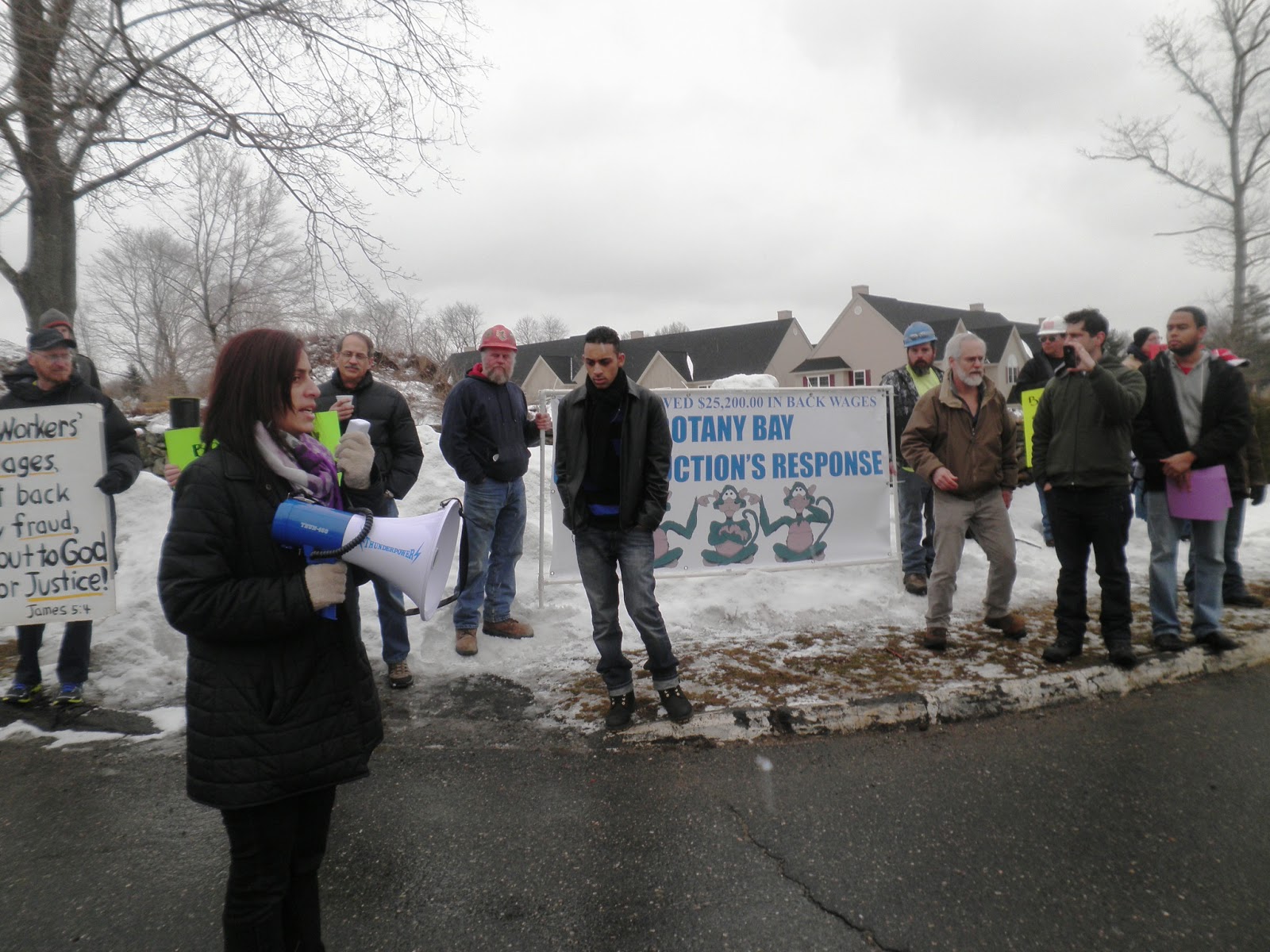
Botany Bay Construction (Worcester MA) wage theft demonstration. Metrowest Worker Center (Casa) and Carpenters Local 107 come together to support 5 construction workers who together are owed $25,200 in back wages for work they did. The men did such quality work that Botany Bay (the project general contractor) offered to hire them after the subcontractor, Fastway Builder, took off without paying the workers for work already done. General contractors are responsible for the work in its entirety, both the finished product and for having hired a scam subcontractor with a history of nonpayment. It is time for the contractor to do the right thing and pay the workers. The money is a drop in the bucket for the project but essential to these workers and their families.

Allies stand with the workers in front of the construction site.


Worcester Councilwoman Sarai Rivera addresses the group. 

Scott Shaffer-Duffy of the Worcester Catholic Worker house, addresses the group, reminding us (and Botany Bay Construction) that the Bible is very clear - workers should be paid for work done.


Thursday, December 20, 2012

I write with a heavy heart.  A cold wind blows out of the north and the temperature is dropping.  A few nights ago, when RI did it’s “Point in Time” count, 996 people were homeless.  So far this year, 214 families, with 385 children, have been sheltered – up from 159 last year.  Last year, in Massachusetts, 16,664 were homeless when that count was done.  (Click here for images from the RI Press Conference on homelessness, including photos of Harrington Hall.)

And Congress sits on its hands about continuing to offer long term assistance (instead of just 26 weeks) to people who are unemployed.  If they fail, thousands of people in MA and RI will lose what little income they have and be even more at risk of homelessness.

There is political will (appropriately) to respond to the devastation wrought by Hurricane Sandy – yet little or no political will to respond to the disaster of thousands of people, including children, homeless in the winter in RI and MA.

And Congress dithers over the so called “fiscal cliff”, putting funding for homelessness and affordable housing in jeopardy instead of showing a small bit of courage to slash funding for the boondoggle F-35 plane (that flies so badly some pilots refuse to fly it, is way over budget and willcost over $1 trillion dollars over the next 10 years) . 

Nor do they seem to find the will to return tax levels to what they were a few years ago (still way lower than what they were 30 years ago) so that the wealthiest can help alleviate the suffering we see all around us in our communities.
We were all painfully reminded of the fragility of life with the shootings in Newtown last week.  We could so easily place ourselves in the shoes of the people of that community.  We are asking important questions about gun control but also about mental health care in this country.  I am grateful at that new energy and you will hear more on this in coming weeks.
But tonight it is homelessness that tugs on my heart.  Until homelessness and/or mental illness touches your family, the urgency of addressing the utter inadequacy of mental health care and assistance for those who are most in need in this country remains just an abstraction.  But standing in an old gymnasium with row upon row of metal bunk beds housing about 100 men every night breaks my heart every bit as much as the tragedy in Newtown and carries its own urgency.    With both situations, the tragedy is felt more acutely because we know that it doesn’t have to be this way.  We know how to fix these problems.
Our task is to use our voices to insist that the manufacturers of tools of death and war are put in their place and the resources shifted to support life and true security.
Here are some ways you can do that:
·         Call your congressman or senator and insist that they stop dithering and put people before the profits of the weapons (from guns to F-35s to nuclear weapons)makers and fund our communities not war and guns.   Or use the AFSC action page for this.
·         Sign petitions in support of tax increases for the wealthiest, cuts in military spending, gun control, funding for mental health care, etc..  Any one of these may not mean much, but together they are creating public noise that is getting harder for Congress to ignore.
·         Donate to your local shelter or food pantry or food bank.  Some places look for volunteers, others just need money to keep the doors open.
·         Donate to AFSC-SENE so that we can work with you to change our country’s priorities.
I want to end with a story.  During the press conference today I was handed a brochure that had the photo of a man who died this past year when his camping lantern caught the tent he lived in on fire.  Tears unexpectedly welled up in my eyes as I thought of all the homeless men and women in NH whose funerals I had presided over.  A man standing near me gently touched my arm.  He had been friends with the man and told me about him.  He always worked, just never had enough to rent an apartment.  He never asked for help – he was proud.  And he was ashamed of the fact he couldn’t read, so he just did the best he could.  As for himself, he had finally accepted shelter.  He said he is clean and sober.  Just couldn’t find work.  When he lost his job several years ago in the recession, and his marriage fell apart, he left his wife with the house.  “I got sisters.  I wanted her safe.”  He said that staying there was hard  (imagine trying to sleep in a big open room with 100 other people!) but he was grateful for it.  And trying to keep hope alive that he can put his life back together.
Please do what you can to help.  Thank you.  And may your holidays hold fellowship and renewal.

Sunday, October 14, 2012

Surviving Electoral Madness

Ah what a difference a year makes.  A year ago Occupy Providence was setting up in Burnside Park with thousands of people showing up for the first day march.  Occupy Wall Street was a month old and Occupy groups were organizing on Cape Cod, in Worcester, Fall River and New Bedford.  There was an excitement in the air as people found a way to have a voice and call for substantial change.  Images of police out of control, pepper spraying  young women in New York and elsewhere grabbed the attention of people who had managed to ignore the abuses the police daily dish out on people of color and homeless people every day and people said enough.  The media eventually woke up and regualry carried the messages of ordinary people voicing their anger and frustration with corporate domination, the phenomenal concentration of wealth in the hands of a few and their desire to have a hand in reshaping how things work.  It was exciting and energizing.
A year later, on this anniversary of the start of the Providence Occupation, we are awash in election frenzy.  It feels like the flip side of Occupy - lack of engagement, disgust at the lies and anger at millions of dollars wasted promoting the lies when people can't find jobs and children are hungry.  It is a phenomenal display of everything Occupiers opposed.
So what do we do? I totally understand the impulse to tune it all out.  There may be periods of time that we need to do that for our own sanity.  (I recently spent of a week of vacation sitting on a rock on the edge of a bay in Maine watching the tide change and the eagles feed their youngster - and it was wonderful!)  But we also have to find ways to keep on doing the work of building a more just and peaceful world.
AFSC stays focused on the issues - it doesn't matter who the candidate is, or who is elected - these are the things we call for - end the wars, heal the wounded and repair the damage of war, support non-military solutions to conflict through the transforming power of love and active nonviolence, redirect military spending to meeting human needs,and address the injustices that lead to conflict.
In a time when the wealthly elite/corporate corruption of the political system is so blatent, it is hard to care about it or feel like we have a voice.  And the reality is that, on the federal level, at this point we don't have much of a voice - though we do need to vote anyway.  There are fundamental differences between the candidates and it does matter.    But we can recognize that we do have more of a voice at more local levels.  So perhaps that is where we focus the bulck of our energy.
The challenge is to revive the idea that citizenship is way more than voting once a year.  It is about community organizing - people working together for change.  We both build the world we want and confront the ways the system blocks those efforts.  We build community and build power.  And we use that power to hold the people we elect accountable to the will of the people who elect them - all year long.  We all know that - but I think we need to collectively recommit to it.
And that is where the Occupy movement and all the amazing ongoing efforts to challange injustice give me hope.  People do care and are passionate about making change.  The big wave of occupations has receded, but all kinds of amazing things are going on, some of them direct off-shoots of that organizing and energy.
  • People are forming worker cooperatives, time banks and other things that create a more sustainable economy that is in solidarity with people for whom "the system" has never worked.  At the SAGE conference in Worcester this weekend people wrestled with the complex realities of putting those values into action - and the energy and the work was inspiring.   The Sage Alliance will continue that work after the conference. 
  • A retreat of people working to change the rules on who can get a drivers license in RI  had new members and a great strategic planning session. 
  • The Center for Nonviolent Solutions is teaching youth about healthy uses of power and nonviolent ways of solving conflicts, and celebrates the life work of Michael True, one of the CNVS founders at a luncheon on Oct. 20th.
  • Witness for Peace is touring a woman from Colombia who works in the Indigenous Peoples Movement for Justice. 
  • People on the Cape are addressing the problem of homelessness.
We publish a calendar full of ways to get invovled.  Check it out.   Claim your power and lend it to building a more just and peaceful community and world.  It is a great anti-dote to the mind-numbing pandering and lying the media insists on calling the democratic process.
Facebook

Thursday, June 7, 2012

Turning of the seasons....

Sandy cliffs towered behind me, the ocean rolled in with moderate waves before me.  The beach stretched on in each direction, with no other human in sight.  Strong sun warmed my skin in the cool air.  The National Seashore on Cape Cod is a gem in the lovely days after Memorial Day and before the summer crowds arrive.  I am grateful for those who worked to preserve it and grateful for a little time to let the rhythm of the waves and the calls of the birds sooth the spirit.
Early June is a turning time in organizing, as well.  The state legislatures are in their final days, which will require all the energy that can be mustered.  It has been a frustrating year.  While some really bad bills were stopped, most of the bills that would make life better for people of color or people who are low income are going nowhere.  The footprint of monied interests/corporate power is everywhere.  As in Wisconsin, money rules and it is very skilled at protecting its interests.  If you can show up at the RI state house on Thursday and Friday, there will be many things you can buttonhole legislators about.  See our State House Watch for legislation to keep talking to them about.  Not on that list are the bills to address tax equity (trickle down is not working, time to end a failed policy and put back the taxes that were lowered a few years ago).  If you can't be at the state house, phone calls are good!  The same process is in place in Massachusetts.
Once that madness is over, the tide shifts.
PLEASE HELP WITH THIS EFFORT!   June is the month in Massachusetts to collect signatures to put the Budget for All resolution to a vote by the people.  WE NEED YOUR HELP collecting signatures to get the resolution on the ballot. PLEASE contact us if you are able to help collect signatures!  It is really important to have a variety of towns and cities get the item on the ballot.  It only takes 200 signatures for a state house district - grab a few friends and head to the farmers market, local ball fields, grocery stores, etc to collect signaturs.  We will most eagerly help you learn all you need to know to do that.
Windows and Mirrors is coming to Providence!  Windows and Mirrors: Reflections on the War in Afghanistan is a traveling mural exhibit that makes a powerful statement on a nearly invisible reality.  The exhibit consists of more than 45 large scale paintings by artists from all over the country that memorialize Afghan civilian casualties.  The exhibit includes images collected from Afghan high school students by Dr. Zahir Wahab, a professor at Lewis and Clark College, who asked young Afghans to draw images from their daily reality. The exhibit will open at the URI downtown Providence campus on July 9th.  There will be special events every Thursday through July and most of August, as well as several other events.  Please plan on visiting!
I hope that each of you will find some time as the tide turns to change your pace and renew your energy.  For your summer reading, AFSC posted recommended books on War and Peace in the fall issue of Quaker Action.  Click here to go to that edition then scroll through toward the end of the issue.  There are some great suggestions.
In Peace,
Martha Yager

Saturday, March 3, 2012

Women Making a Difference

We sat in the kitchen of our host family, talking about migration. The husband of one of our hostess's sisters had moved with his family from the village of Teotitlan de Valle to the U.S. when he was ten and stayed there through college. He came back to reconnect with his roots and fell in love. They now have three children. At one point he returned to the U.S. to earn money to build a house. As one of the women pointed out, it is possible to make enough money to live, but hard to save. one of the sisters had worked in New Haven for awhile and now does domestic work in Mexico City. One brother left for the States years ago but they have never heard from him and have no idea if he is dead or alive.


Most families shared similar stories of migrating north. Some went as kids only to be deported to places they have no connection to as young adults. Some went for 20 years or more then came back to care for elders or were deported. Some found ways to go with documents, but that is terribly expensive. It is clear that there was a long history of movement back and forth across the border. Both countries thought little of it until 1) NAFTA began destroying the rural economy and 2)September 11 intensified a focus on sealing the border and criminalizing undocumented migration.
Charlie spoke of the pain of deportation, forcing him to leave behind two daughters and returning him to a place he had left when he was a small boy. 
 Our home-stay was arranged as part of our visit to a women's collective called Vida Nueva. It's current form began with a group of 14 women, some of them single, who built on the work of a previous group to help women build their own economic security through developing their own handicrafts businesses. The area is known for its weaving, but they also developed a candle business and a pastries business. The goal was to help the children in the family, especially the girls, be able to stay in school longer so they would have more opportunities. They helped the girls learn the local folk dances, and all were thrilled as they entered local dance competitions.
Women from the collective in the front row.
In 2000, after hearing ads for government programs to help local development, they decided to apply. That began a huge learning process, taking them to Oaxaca city for the first time. They got connected with NGOs and began doing more in the community on many levels. They held workshops on running a business, domestic violence, women's health issues, learning Spanish (many still speak Zapotec at home). And they began saving as a group for projects to help the collective and the community. (The community still is run in the old way, with collective decision making and required community service.)

In 2006 they decided to do a project for the community. Concerned about the impact on their health by the wood stoves in the kitchen, they worked with a student from Oregon to build ecofriendly stoves and toilets. In a year they did 30 stoves.

In 2007 they decided to place trash bins on Main Street with an awareness-raising message on them. At first there was resistance, then support from the town. The bins are still in place and the town now has added more.
One of the recycling bins near the market place.


Next was a project of care baskets for older women without children. Again, their small project grew beyond their dreams.

In 2009 they decided to tackle reforestation, beginning in a small way with the 30 trees they could afford. (tree cutting, both by local people and by timber companies has and a bad impact on the ecosystem.) Because much of the land is held in common, they had to go to the town government to ask permission for where to plant their trees. The council decided that this was a good project and that to protect the trees, everyone needed to be involved. They required a community service day for the preparing of the land and the planting. In the end 600 trees were planted and a fence built around it to,protect the small trees from grazing animals. They created a committee to care for the trees, so that they get watered every day in the dry season. Young people caught drinking too much or in other trouble may be sent to care for the trees as a way of repairing their relations with the community.

Food is a chronic problem. In a community without a lot of cash, growing your own food is a good idea. In 2011 they began a project to help people grow small gardens both to feed their families and to sell extras in the local market. They have held workshops helping people learn what they need to know food.

All of this has played a role in changing the possibilities for women in the community. Women play a more active role in the community assemblies. More girls are staying in school for longer times, and young women have access to information about health issues and domestic violence. They have ways of selling the stunning woven tapestries they make, as well as other handcrafts.  And when there is more economic security, there is less need to migrate.


It was a deeply complex visit, full of both inspiration and the sadness so families pulled apart by migration and deportation. And great beauty in the physical setting and in the crafts.


We returned today in time to see a huge (500-800 people) march through Oaxaca, ending at the nearby zocalo, of teachers, teachers in training and students protesting privatization of education, the closing of the community college (which is free, making education accessible to indigenous youth from the villages)and other education "reforms". Their energy and creativity was great! Slogan of the day "Revolution is not an act of rebellion- it is an action for justice!".